
Book review
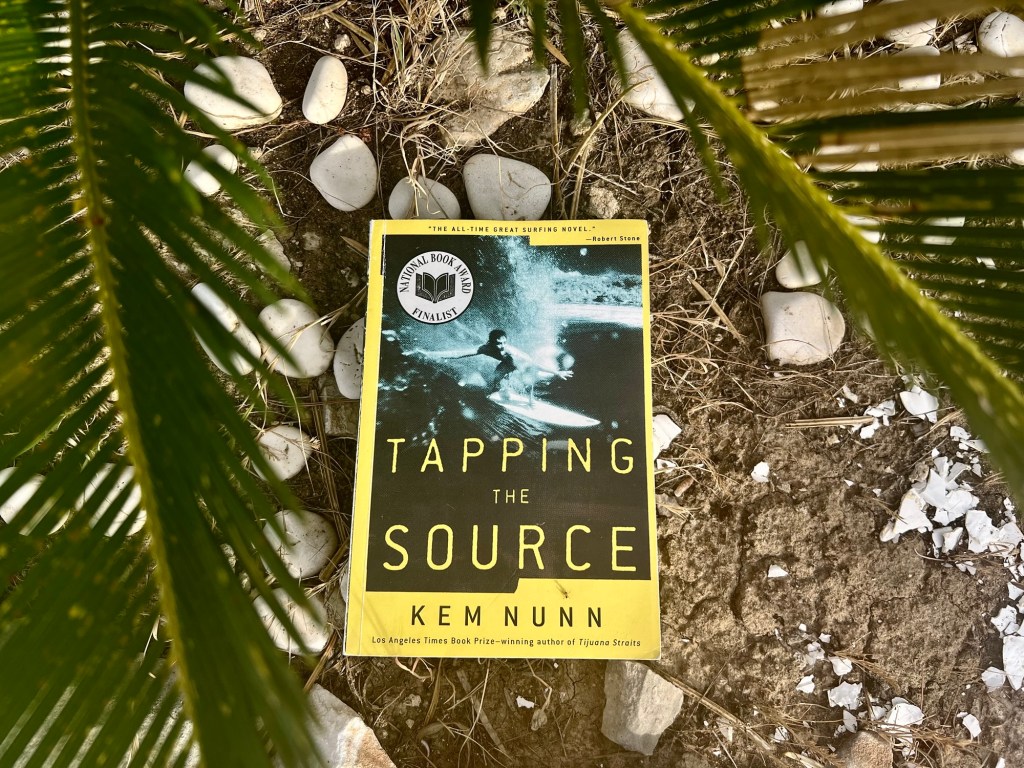
Tapping the Source – Kem Nunn (1984)
Words by Kenneth Erlandsen
How Kem Nunn’s 1984 debut novel, the book widely credited as the cornerstone of “surf noir”, managed to slip past me until 2026 is honestly a mystery. I’m still a little embarrassed about it, even now that it’s read and I’ve earned my place among the initiated. You should join us too.
Surf noir is a genre Nunn didn’t just write into- he invented it, and Tapping the Source remains the yardstick every surf novel since has been measured against.
The book wastes no time getting going. Ike Tucker, an eighteen-year-old from a dusty backwater town in inland California, gets an unannounced visit from a stranger who tells him his sister has vanished and that he suspects the three named men she was last seen with had something to do with it.
Ike’s search for his sister Ellen leads him into the surf scene around Huntington Beach, and what starts as a missing-persons hunt slowly curdles into something much darker: biker gangs, drugs, cult-like devotion, and a surf crew that operates less like a beach community and more like an organized crime outfit. It is a far cry from the sun-bleached, carefree culture the book seems to promise in its opening pages.
The novel’s central villain, a man named Hound Adams, is a chillingly good study in nuance — a man with both good and bad in him, same as the rest of us. The difference is that Hound Adams lets the bad win. That’s what makes him such a genuinely unsettling, unpredictable character, one of the best I’ve come across in crime fiction.
Without giving too much away about where the timeline and plot end up, it’s worth saying this: what begins on a hopeful note ends up somewhere a lot bleaker, among some thoroughly wrecked lives.
I lost myself completely in this book and tore through it in two days on summer break.
Tapping the Source is required reading for every surfer and crime enthusiast.
Its place in surf history
Before Nunn, surf literature mostly meant romanticized odes to sand and swell. Tapping the Source flipped that on its head. Nunn, a surfer himself, took the sport seriously as literary material, but stripped away the glorification. What he gave readers instead was a surf scene rendered as a closed, almost tribal world, complete with its own hierarchies, rituals, and senseless violence simmering just beneath the surface.
The novel was a finalist for the National Book Award, which handed surf literature a legitimacy it had rarely enjoyed before, and it’s served as the blueprint for everything that’s since been filed under surf noir.
Its pop culture footprint
The book’s best-known afterlife is as the inspiration behind Point Break (1991), starring Patrick Swayze and Keanu Reeves. The film’s plot isn’t a direct lift from the novel, but the mood, the near-religious devotion to chasing the perfect wave, the idea of surfing as something dangerous and existential, is pulled straight from Nunn’s pages. Nunn himself has said there’s not much overlap between the book and the film, and honestly, I agree with him. If there’s a real throughline, it’s in how both portray the criminal underworlds built on a foundation of surfing. I’d also argue there’s a kinship between how Hound Adams is written and how Swayze’s character is played — both nuanced, complicated men caught in the no-man’s-land between a lawful life and a criminal one.
After Tapping the Source, Nunn built a career as a TV writer, working on shows like Deadwood and Sons of Anarchy. Together with David Milch, he co-created the HBO series John from Cincinnati, which shares a lot of DNA with the world of Tapping the Source. If you haven’t seen it, do. It got roughed up by critics and wasn’t renewed past its first season, but I liked it a lot. It has a genuinely singular atmosphere, and it gave Greyson Fletcher (yes, son of Christian Fletcher) a lead role he handled with real skill. It also proved he is a really good surfer, even if these days he’s best known as a proffesional skateboarder.
Why read it in 2026?
A book from 1984 might sound like a relic, but Tapping the Source has aged remarkably well. For one, the prose is still some of the finest you’ll find in American crime writing.
Nunn writes about swell and light on water with a precision that puts the salt in your nose. For another, the themes haven’t dated a bit: at its core, this is a book about how subcultures — surfing, online communities, ultra fotball fans, any closed-off group — can offer real belonging while also masking exploitation and power plays behind a facade of freedom and fellowship. That’s a theme that’s arguably gotten more relevant, not less, in an era where people are still chasing something authentic and unmediated in an increasingly digital, commercialized world.
For anyone who only knows surfing through Instagram aesthetics and adrenaline-movie tropes, Tapping the Source is a solid reminder that the pull of the perfect wave has always had a darker undertow, and that a genuinely good, honest story never really goes out of print.

 27 - 9
Leave a comment